
Guide
Offset or digital: how the choice is made
Neither method is better. One has a set-up cost and a low cost per sheet; the other has almost no set-up and a higher cost per sheet. Almost everything else about the decision follows from that.
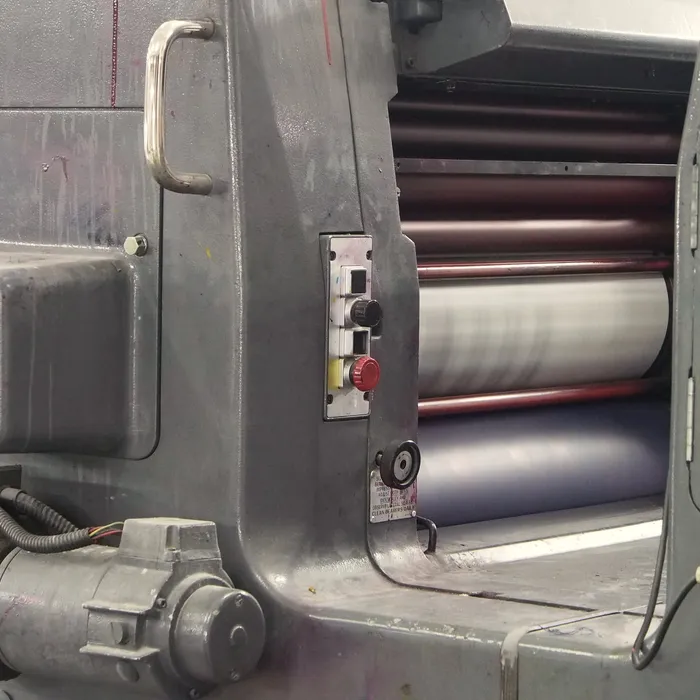
At a glance
- Set-up
- Offset: plates made for each job and the press made ready before the first good sheet. Digital: the file is printed directly; minutes rather than hours.
- Cost per copy
- Offset: falls steeply as the run grows, because the set-up is spread over more sheets. Digital: roughly flat, whatever the quantity.
- Colour
- Offset: brand colours as spot inks or matched CMYK, consistent across the run. Digital: CMYK, good on photographs, slightly more variation sheet to sheet.
- Stock
- Offset: the widest range — uncoated, textured, heavy board, carton and label materials. Digital: coated and uncoated papers and lighter boards.
- Where each wins
- Offset: commercial quantities, exact colour, packaging and labels. Digital: short runs, versioned work, proofs, jobs needed quickly.
The economics in one picture
Imagine the cost of a job as a line on a graph against quantity. Offset starts high — the plates and make-ready are paid before a single sheet is sold — and then rises very gently, because each extra sheet costs only paper, ink and a few seconds of press time. Digital starts near zero and rises in a straight line, because every sheet costs about the same as the last. The two lines cross somewhere, and that crossing point is the whole decision. It moves with the job: a single-colour item crosses early, a 32-page full-colour catalogue later, and a job on a board that digital cannot run never crosses at all.
This is why a quotation often shows two quantities. The price for 500 and the price for 1,000 are rarely in proportion, and seeing both tells you where your job sits on the curve.
Colour
Offset ink density is set once and holds, so the last sheet matches the first and a brand colour can be mixed as a spot ink rather than approximated. For a set of items that must match — a catalogue cover, its labels and its carton — that consistency is the reason to print them together on one press. Digital colour is good and improving, and on coated stock with photographs the difference is small, but a critical brand colour or a large flat area of a single colour is where it shows.
Paper and board
Offset puts ink down through a rubber blanket, which conforms to texture and takes heavy, uncoated and specialist stocks in its stride. Digital presses fuse toner or ink to the surface and have limits on thickness, texture and coating. If a job is defined by its stock — a textured uncoated card, a heavy carton board, a particular label material — the method is often decided before the quantity is discussed. The paper and board guide covers the stocks themselves.
Finishing is the same either way
Lamination, foil, Spot UV and die cutting are applied to the printed sheet afterwards and do not care how the ink got there, with one caveat: some digital surfaces need a different laminate or a test before foil or varnish will bond reliably. Say at the quotation stage which finishes you want, and the method is chosen with them in mind.
Speed
Digital removes plate-making and make-ready, so a short run can move faster through the shop. On a long run the press speed of offset recovers that difference many times over. Timing for either is counted from artwork approval and depends on finishing, stock availability and the schedule; each product page carries an indicative timeline.
How we decide
We look at quantity first, then the stock, then how critical the colour is, then the date. Most jobs sort themselves out at the first question. Where they do not, we quote both methods and say which we would choose and why. Tell us the quantity and what the piece has to do; you do not need to specify the method yourself.
Common questions
At what quantity does offset become cheaper than digital?
There is no single number. Offset carries a fixed set-up cost for plates and make-ready and then a low cost per sheet; digital has almost no set-up and a higher cost per sheet. Where the lines cross depends on the size, the number of colours and pages, and the stock. For small items it can be a few hundred copies; for a multi-page catalogue it can be lower. Ask for both quantities on the quotation and the comparison is made for you.
Does digital look worse than offset?
On coated paper with ordinary photographs, most people cannot tell them apart. Offset holds very fine detail, large even solids and exact brand colours more reliably, and prints on a wider range of papers and boards. Digital can vary slightly from sheet to sheet and across a long run. Which difference matters depends on the piece.
Can digital print on the same papers as offset?
Many, but not all. Very heavy boards, textured and uncoated specialist stocks, and some label and carton materials run offset only. If the stock is the reason for the job, it may decide the method on its own.
Can I switch methods between a first run and a reprint?
Yes, and it is common: a short digital run to launch, offset once the quantity justifies plates. Expect a small colour difference between the two, and tell us it is a reprint so the specification is matched as closely as the method allows.
Planning a print job?
Send the product, quantity, size and finish you have in mind and we will price it. If the specification is not settled yet, describe what you are producing and we will work back to the stock, print method and finishing that suit it.
- Call
- +94 74 281 3330
- Not sure what to specify?
- Use the specification helper