
Die cutting
Die cutting is what lets printed work stop being a rectangle. It is also what turns a flat printed sheet into a box that folds square and stays shut.
How it works
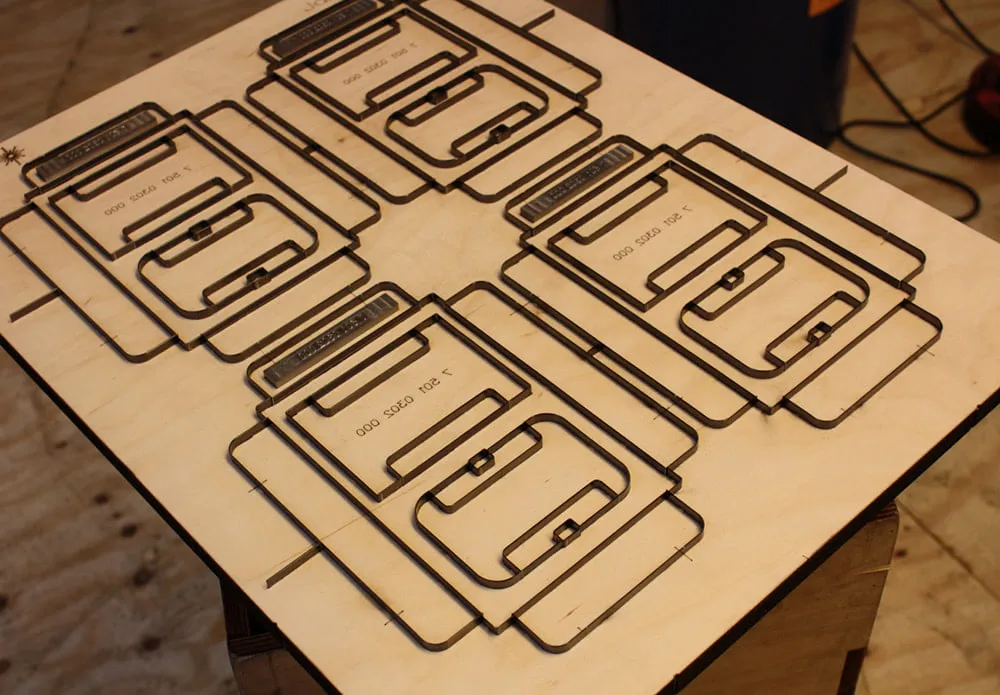
Steel rule is bent to follow the outline of your shape and set into a board — the forme. Cutting rule goes where the sheet must be cut through; creasing rule goes where it must fold without breaking. The forme is then pressed against the printed sheet, and every cut, crease, slot and window is made in a single operation.
Because the forme is made specifically for your shape, die cutting is not limited to standard formats. It is limited by what the board will physically do — which is where the design considerations below come in.
What we cut
- Carton and box structures, including tabs, slots and tuck-in flaps
- Windows in packaging and presentation folders
- Labels and stickers cut to an outline rather than a rectangle
- Rounded corners on cards, tags and inserts
- Hanging holes and shaped promotional pieces
Designing for the cut
Three things cause most problems. Sharp internal angles concentrate stress and can tear as the sheet is stripped from the forme. Narrow tabs and thin ligatures lose strength once the board is creased. And elements placed too close to a cut line look misaligned if the sheet moves even slightly during the run.
Keep type and logos clear of every cut and crease, and run background colour and images past the cut line so a small shift never leaves a white edge. If you are working to a dieline, keep it on its own layer so it can be removed before printing.
Where die cutting fits in the sequence
Cutting comes last. The sheet is printed, then laminated, then Spot UV or foil is applied, and only then is it cut to shape. Doing it in that order gives a clean cut edge through the finished surface instead of a laminate that lifts at the corners.
Formes stay with the job
A forme is a physical object — steel rule set into a board, cut to your outline. Because the cutting is done at the Grandpass Road workshop in Colombo rather than sent out to a separate finishing house, the forme made for your job stays with the job, and a reorder can run against the one that already exists instead of starting with a new one. Say at the first order if you expect to reprint, because a forme built for a single short run and one built to be used repeatedly are not always specified the same way.
What to tell us
- The finished shape — a drawing, a dieline, or a physical sample
- Whether it folds, and where
- Any windows, slots or holes, with their positions
- Quantity, and whether you expect to reorder the same shape
A flattened example of something similar is often the fastest brief. If you do not have one, describe what the piece has to do and we will work the structure out with you.
Indicative timing
How long a job like this takes
Foil, Spot UV, lamination or die cutting on work printed elsewhere.
Before production approval
These run alongside each other and depend on how quickly proofs come back. The production estimate below starts once they are approved.
- Artwork and proofing1–3 working days
Per proof round, from when we have your content. Depends on how quickly proofs come back to us.
After approval — production
Counted in working days from approval of the final artwork or specification and any payment the quotation asks for.
- FinishingConfirmed with the quotation
Confirmed after we have seen the printed sheets or a sample — the surface decides what will bond to it and how long it needs.
Then
- Collection or deliveryConfirmed with the quotation
Arranged when the job is quoted. Tell us at the enquiry stage how you would like to receive it.
Planning guide, not a promise. Typical ranges for a first order. The "before approval" stages are not added to the production estimate as a fixed sum — they overlap, and their length depends on the approvals — so a whole job is usually the production range plus however long proofing takes. The confirmed schedule for your job comes with the quotation.
What moves it:
- Whether a new die or forme is needed.
- The condition and stock of the supplied print.
- Quantity, paper or board availability (imported stocks are quoted against their arrival), and the finishing specified.
- Current workload, and Poya and public holidays.
- How quickly proofs, dielines and samples are approved — the "before approval" stages are in your hands as much as ours.
Common questions
What is die cutting?
Steel rule is bent to the outline of your shape and set into a board to make a forme. The forme is pressed against the printed sheet and cuts it to that shape. The same forme carries creasing rule where the piece needs to fold rather than cut.
Do I need to pay for a die every time I reprint?
No. The forme is made once for a given shape and can be used again for repeat orders of the same item. A new die is only needed if the shape or the size changes.
What should I avoid in a die-cut design?
Very sharp internal angles, extremely narrow tabs and cuts that run too close to a fold. Keep important text and logos a safe distance from every cut line, and extend background colour past the cut so nothing shows white if the sheet shifts slightly.
Can you cut a window into a box or a folder?
Yes — a window is cut in the same operation as the outline. Tell us where it falls and how big it is, and whether anything is being mounted behind it.
Planning a print job?
Send the product, quantity, size and finish you have in mind and we will price it. If the specification is not settled yet, describe what you are producing and we will work back to the stock, print method and finishing that suit it.
- Call
- +94 76 620 0995
- Not sure what to specify?
- Use the specification helper