
Foil printing
Foiling puts actual metal on the sheet. It is the one finish that cannot be approximated with ink, which is why it still reads as deliberate when everything around it is printed.
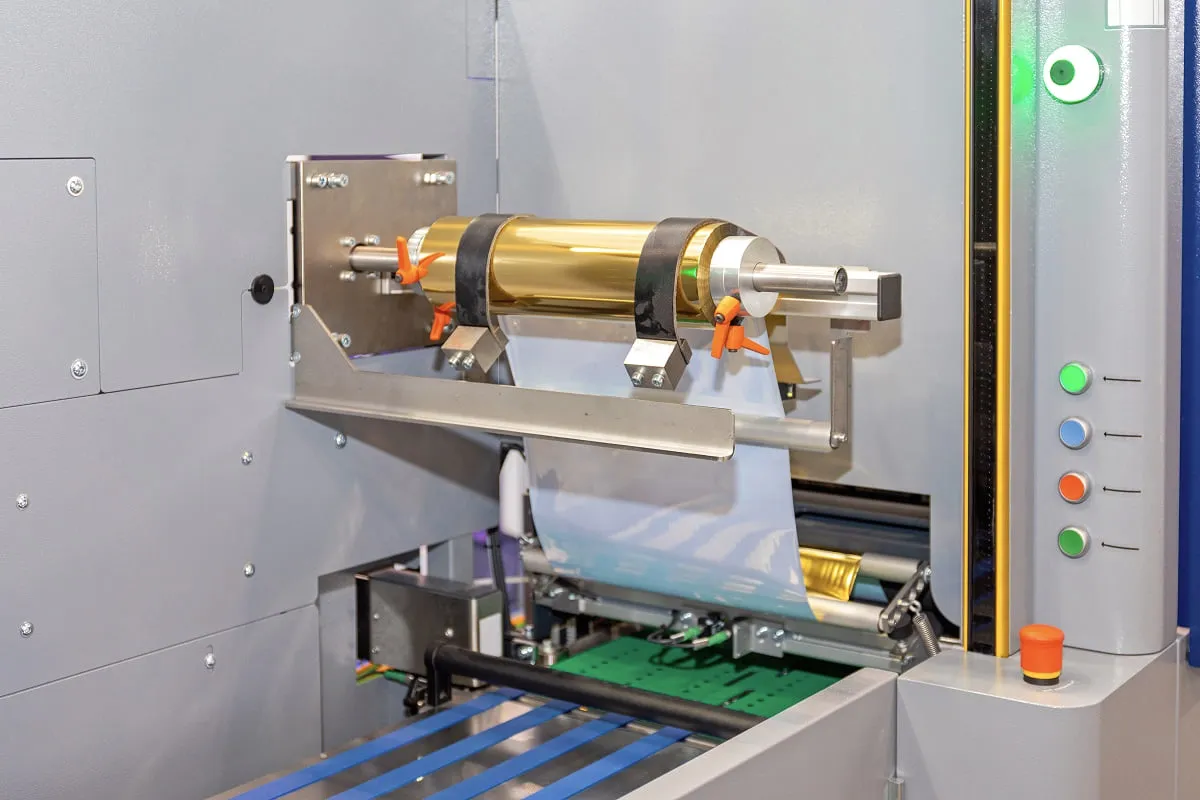
What foiling does
Foil printing, hot foil stamping and foil blocking are the same process under different names. A heated die, made to the shape of your artwork, presses a metallic film onto the sheet. The foil releases from its carrier where the die makes contact and bonds to the surface. Because it is a metal film rather than printed ink, it catches light directly and changes as the piece is turned — an effect that photographs poorly and works properly only in the hand.
Where it is worth using
- Company marks on business cards and letterheads
- Titles and logos on catalogue and folder covers
- Brand elements on retail cartons and gift packaging
- Labels for products positioned above the general range
- Certificates, invitations and formal documents
Use less of it than you think
Foil works by contrast. A single foiled logo on an otherwise plain card is unmistakable; the same card with foil on the logo, the name, the border and the reverse reads as cheaper, not richer. Large solid areas are also unforgiving — any unevenness in the board shows through.
Gold and silver are the usual choices and both are available in a range of tones. Coloured and matt foils exist too; tell us what you are trying to achieve and we will show you what the options look like on the stock you have chosen.
Foil with other finishes
Foil is applied after lamination, not before. Over a matt laminate it has the strongest contrast, because the surrounding surface reflects almost nothing. It can be combined with Spot UV on the same piece — for example foil on the logo and Spot UV over a photographic panel — provided both are planned into the layout from the start.
Letting sheets settle before blocking
Foil is laid down by a heated die under pressure, and it wants a sheet that is flat, dry and settled. In Sri Lanka's humidity a freshly printed sheet holds more moisture than it will a day later, and blocking one too early is how foil lifts at the edges or takes on a ragged edge. Giving printed sheets time to settle before the foil goes on is part of the normal sequence here rather than a hold-up — and it is another reason foil is decided before the sheet is laid out, not added once the printing is done.
Artwork and set-up
- Supply the foil areas as a separate layer, solid black at 100%
- Keep foil elements clear of folds, creases and cut lines
- Avoid hairlines and very small type in the foiled areas
- Tell us the foil colour, or ask to see options before committing
Each foiled design needs its own die, which is a one-off cost for the job. Repeat orders of the same artwork can use the die again.
Indicative timing
How long a job like this takes
Foil, Spot UV, lamination or die cutting on work printed elsewhere.
Before production approval
These run alongside each other and depend on how quickly proofs come back. The production estimate below starts once they are approved.
- Artwork and proofing1–3 working days
Per proof round, from when we have your content. Depends on how quickly proofs come back to us.
After approval — production
Counted in working days from approval of the final artwork or specification and any payment the quotation asks for.
- FinishingConfirmed with the quotation
Confirmed after we have seen the printed sheets or a sample — the surface decides what will bond to it and how long it needs.
Then
- Collection or deliveryConfirmed with the quotation
Arranged when the job is quoted. Tell us at the enquiry stage how you would like to receive it.
Planning guide, not a promise. Typical ranges for a first order. The "before approval" stages are not added to the production estimate as a fixed sum — they overlap, and their length depends on the approvals — so a whole job is usually the production range plus however long proofing takes. The confirmed schedule for your job comes with the quotation.
What moves it:
- Whether a new die or forme is needed.
- The condition and stock of the supplied print.
- Quantity, paper or board availability (imported stocks are quoted against their arrival), and the finishing specified.
- Current workload, and Poya and public holidays.
- How quickly proofs, dielines and samples are approved — the "before approval" stages are in your hands as much as ours.
Common questions
What is foil printing?
A metallic film is pressed onto the sheet using a heated die shaped to your artwork. Where the die touches, the foil releases from its carrier and bonds to the paper. Nothing is printed in the usual sense — the metal itself is transferred, which is why it reflects light the way it does.
Which artwork works best for foiling?
Logos, type, rules and line work. Fine hairlines and very small text can fill in or break up, and large solid panels tend to show every imperfection in the board. If a piece of artwork is borderline, tell us and we will say whether it will hold.
How should I supply foil artwork?
As a separate layer or a separate file containing only the areas to be foiled, in solid black at 100%, positioned exactly where they fall on the printed artwork. Do not use a metallic colour to indicate foil — that only creates confusion about what is printed and what is stamped.
Can foil be printed over?
It is better not to. Ink does not sit reliably on a foiled surface. Design the printed artwork and the foil areas so they sit next to each other rather than on top of one another.
Planning a print job?
Send the product, quantity, size and finish you have in mind and we will price it. If the specification is not settled yet, describe what you are producing and we will work back to the stock, print method and finishing that suit it.
- Call
- +94 76 620 0995
- Not sure what to specify?
- Use the specification helper