
Lamination
Lamination is the least glamorous finish and usually the most important one. It decides how the printed surface survives being handled, and what every other finish gets applied on top of.
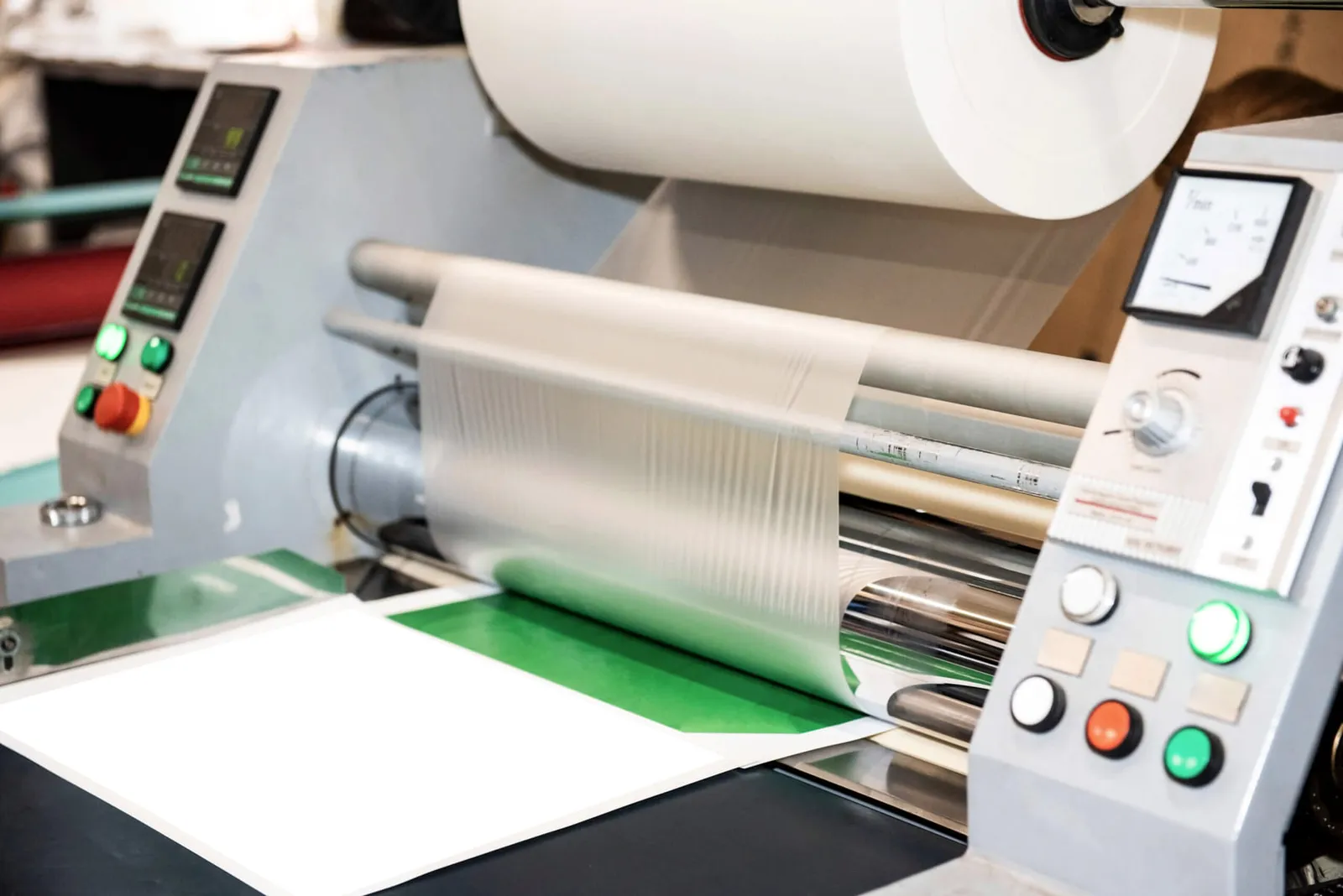
What lamination does
A thin film is bonded over the printed sheet under heat and pressure. It seals the ink, so the print no longer scuffs against other stock or picks up marks from handling. It adds a small amount of stiffness, which matters on covers and cartons. And it fixes the surface character of the piece — everything afterwards is judged against that surface.
Gloss and matt
Gloss increases the apparent depth of colour and makes photography look sharper. It is the obvious choice for product packaging and anything driven by imagery. It also shows fingerprints on dark areas, which is worth knowing before specifying it for a black cover.
Matt does the opposite: it lowers contrast slightly, removes glare and gives a soft, dry feel that reads as more considered. It is the standard base for Spot UV, because the gloss varnish needs a non-reflective surface around it to be visible at all.
Where it earns its cost
- Catalogue and brochure covers that are handled repeatedly
- Business cards, where the surface is judged by touch
- Product labels exposed to wiping, moisture or friction
- Retail cartons that have to survive transit and stacking
- Menus, folders and anything used daily rather than read once
Why so much work here is laminated
In a temperate market lamination is largely a decision about how a piece should look. In Sri Lanka's humidity it does structural work as well: it seals the printed surface against moisture, which is what keeps a cover from curling at the fore-edge and a carton panel from softening in unconditioned storage. That is why a great deal of what leaves here is laminated even where the design on its own would not have called for it. If a piece is going to live in a car, a store room or a warehouse rather than an air-conditioned office, the question is usually which lamination rather than whether.
Practical points
Laminating one side of a light stock can cause curl, because the laminated face and the bare face respond differently to humidity. On thin sheets, laminating both sides usually solves it.
Lamination is applied before die cutting, not after. Cutting through a laminated sheet gives a clean edge; laminating an already cut shape tends to lift at the corners.
What to tell us
- Gloss or matt — or ask us to recommend one for the job
- One side or both
- Whether Spot UV or foil is going on top of it
- How the finished piece will be handled and stored
Indicative timing
How long a job like this takes
Foil, Spot UV, lamination or die cutting on work printed elsewhere.
Before production approval
These run alongside each other and depend on how quickly proofs come back. The production estimate below starts once they are approved.
- Artwork and proofing1–3 working days
Per proof round, from when we have your content. Depends on how quickly proofs come back to us.
After approval — production
Counted in working days from approval of the final artwork or specification and any payment the quotation asks for.
- FinishingConfirmed with the quotation
Confirmed after we have seen the printed sheets or a sample — the surface decides what will bond to it and how long it needs.
Then
- Collection or deliveryConfirmed with the quotation
Arranged when the job is quoted. Tell us at the enquiry stage how you would like to receive it.
Planning guide, not a promise. Typical ranges for a first order. The "before approval" stages are not added to the production estimate as a fixed sum — they overlap, and their length depends on the approvals — so a whole job is usually the production range plus however long proofing takes. The confirmed schedule for your job comes with the quotation.
What moves it:
- Whether a new die or forme is needed.
- The condition and stock of the supplied print.
- Quantity, paper or board availability (imported stocks are quoted against their arrival), and the finishing specified.
- Current workload, and Poya and public holidays.
- How quickly proofs, dielines and samples are approved — the "before approval" stages are in your hands as much as ours.
Common questions
What does lamination add to printed material?
A thin film bonded over the printed surface. It resists scuffing, fingerprints and moisture, stiffens the sheet slightly, and sets the gloss level of the finished piece. On anything that will be handled more than once, it is usually what decides whether the job still looks new after a month.
Gloss or matt?
Gloss deepens colours and lifts photography, which suits product imagery and retail packaging. Matt lowers glare, feels softer in the hand and reads as more restrained — and it is what Spot UV needs underneath it to work properly.
Does lamination make paper waterproof?
No. It resists moisture on the laminated surface, but the edges are cut through the paper and will still absorb water. Treat it as protection against handling, not as waterproofing.
Can only one side be laminated?
Yes, and it is common on covers. Be aware that laminating one side of a lighter stock can cause it to curl, because the two surfaces behave differently. On thinner sheets, laminating both sides is often the safer choice.
Planning a print job?
Send the product, quantity, size and finish you have in mind and we will price it. If the specification is not settled yet, describe what you are producing and we will work back to the stock, print method and finishing that suit it.
- Call
- +94 76 620 0995
- Not sure what to specify?
- Use the specification helper