
Spot UV (spot varnish)
Spot UV is gloss varnish applied to part of the sheet and nothing else. Set against a matt surface it produces a contrast you notice before you have read a word.
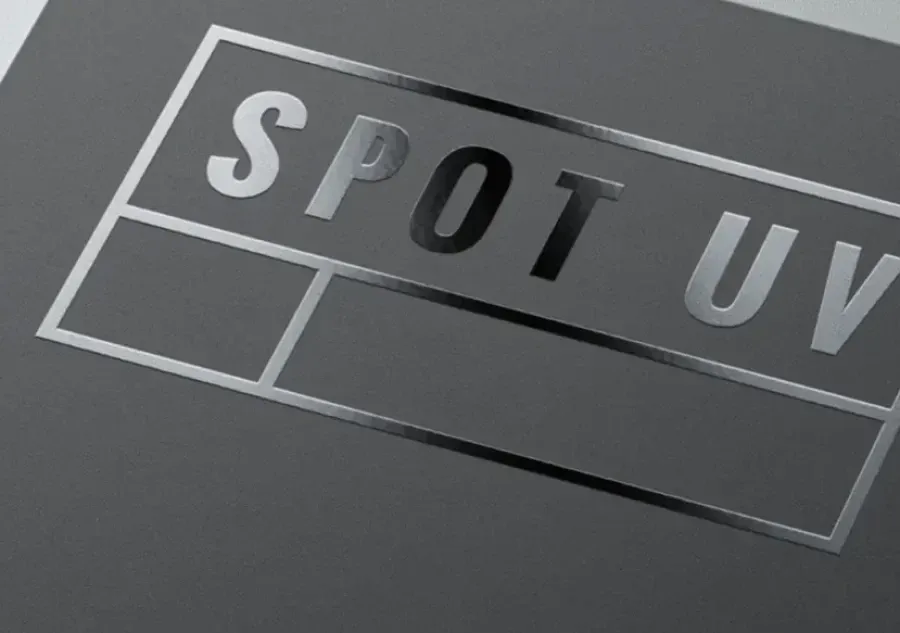
What Spot UV does
A clear varnish is applied to selected areas of the printed sheet and cured under ultraviolet light, which hardens it almost immediately. The varnished areas sit slightly proud of the sheet and reflect light sharply; everything around them stays as it was. The effect is as much tactile as visual — you feel the edge of it before you work out what has been done.
Gloss against matt
Spot UV only works because of what it is set against. On a gloss laminate the varnish has almost nothing to contrast with and the effect disappears. Over a matt laminate the same varnish reads clearly from across a room. If someone has specified Spot UV without specifying matt lamination underneath, that is usually the thing worth checking first.
Where it is used
- Catalogue and brochure covers, over the title or a key image
- Business cards, on the logo or a graphic element
- Retail packaging, over product photography or a brand panel
- Labels on premium goods
- Folders and presentation material
Designing for it
Spot UV rewards selection. Varnishing a photograph, a logo and a background pattern on the same cover cancels the contrast that made it worth doing. Pick one element, or one consistent category of element, and leave the rest matt.
Very fine detail is the other limit. Hairlines and small type can lose their edge, and large solid areas of varnish can show handling marks. If you want the effect across a whole panel, a gloss laminate over the whole sheet is often the cleaner answer.
Spot UV with foil
The two are frequently used together, and they do different jobs: foil is metallic and opaque, Spot UV is clear and lets the printed colour show through. A common arrangement is foil on the company mark and Spot UV over the image — both applied after lamination, both planned into the sheet before it prints.
Printed and finished in one place
Spot UV has to sit exactly on the element it is meant to lift, so registration is most of the job. Printing, laminating and applying the varnish all happen in the same Colombo workshop, which means the sheet is not packed up, moved across the city and unpacked again between stages — and every extra handling between press and finish is a chance for it to shift or scuff. It also means the sheet can be looked at with the person who will run the varnish, rather than described down a phone to another firm.
Supplying artwork
- One layer or file containing only the varnish areas, solid black at 100%
- Aligned exactly to the printed artwork at finished size
- Keep varnish areas clear of folds and creases
- Tell us if the varnish is intended to sit over an image or over a flat colour
Indicative timing
How long a job like this takes
Foil, Spot UV, lamination or die cutting on work printed elsewhere.
Before production approval
These run alongside each other and depend on how quickly proofs come back. The production estimate below starts once they are approved.
- Artwork and proofing1–3 working days
Per proof round, from when we have your content. Depends on how quickly proofs come back to us.
After approval — production
Counted in working days from approval of the final artwork or specification and any payment the quotation asks for.
- FinishingConfirmed with the quotation
Confirmed after we have seen the printed sheets or a sample — the surface decides what will bond to it and how long it needs.
Then
- Collection or deliveryConfirmed with the quotation
Arranged when the job is quoted. Tell us at the enquiry stage how you would like to receive it.
Planning guide, not a promise. Typical ranges for a first order. The "before approval" stages are not added to the production estimate as a fixed sum — they overlap, and their length depends on the approvals — so a whole job is usually the production range plus however long proofing takes. The confirmed schedule for your job comes with the quotation.
What moves it:
- Whether a new die or forme is needed.
- The condition and stock of the supplied print.
- Quantity, paper or board availability (imported stocks are quoted against their arrival), and the finishing specified.
- Current workload, and Poya and public holidays.
- How quickly proofs, dielines and samples are approved — the "before approval" stages are in your hands as much as ours.
Common questions
What is Spot UV?
A clear, high-gloss varnish applied to chosen areas of a printed sheet and cured under ultraviolet light — also called spot varnish, UV varnish or spot gloss. "Spot" means it covers only part of the sheet — the contrast between the varnished and unvarnished areas is the whole point of it.
Does Spot UV need matt lamination underneath?
Not strictly, but it is what makes it work. Gloss varnish over a gloss surface is barely visible. Over a matt laminate the varnished areas lift away from the surface around them, and the difference reads clearly in most lighting.
How do I supply artwork for Spot UV?
As a separate layer or file containing only the areas to be varnished, in solid black at 100%, aligned exactly to the printed artwork. Anything in that layer gets varnish; anything absent from it does not.
Can Spot UV be used on its own without printing?
Yes. Clear varnish on an unprinted matt stock produces a subtle tone-on-tone effect — the pattern is visible only as the light moves across it. It works well on covers and packaging where restraint is the point.
Planning a print job?
Send the product, quantity, size and finish you have in mind and we will price it. If the specification is not settled yet, describe what you are producing and we will work back to the stock, print method and finishing that suit it.
- Call
- +94 76 620 0995
- Not sure what to specify?
- Use the specification helper